When you are with a patient, your phone rings. Your receptionist is tied up with someone at the front desk. Another call comes through, ringing a couple of times before stopping. The caller can leave a voicemail or not.
The bad part is that the caller might have wanted to schedule an appointment with you.
And enters AI receptionist for dentists, not because you need a robot in lieu of your receptionist, but because you shouldn’t have to choose between dealing with the patient sitting in front of you and picking up the cue.
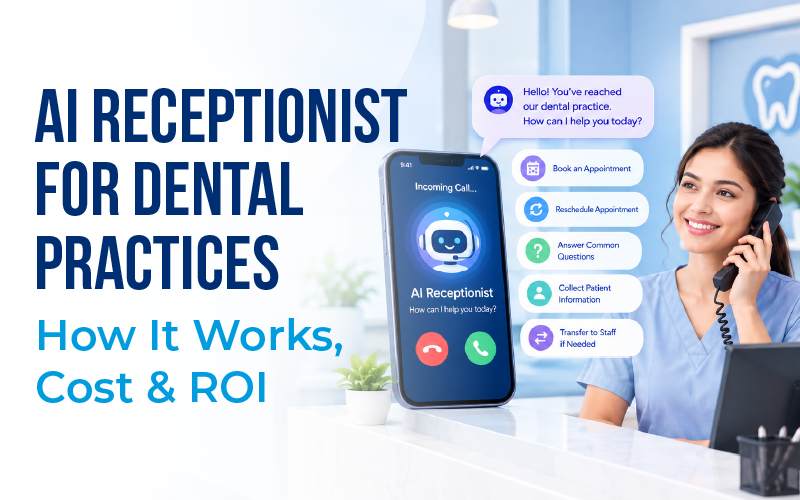
An AI receptionist can pick up calls, manage some of the inquiries, make appointments, get relevant information, and transfer complicated issues to your staff.
However, does it make sense financially? Well, before we find out how it works and how much it costs in practice, let’s see what exactly an AI receptionist is.
What Is an AI Receptionist for a Dental Practice?
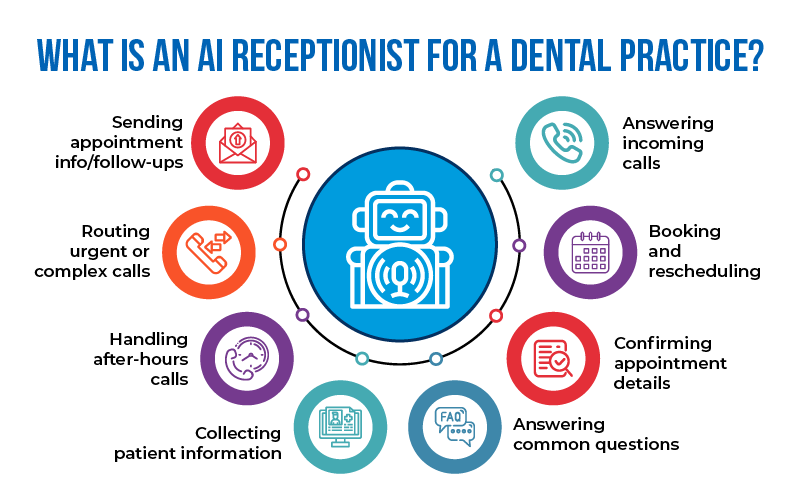
The AI receptionist for dentists is a voice-based system that responds to incoming calls and engages with patients through conversational AI. Envision it as a reception assistant who does not need any lunch breaks, does not take sick leave, and can welcome calls outside the regular office hours.
A good system can typically help with tasks such as:
- Answering incoming calls
- Booking and rescheduling appointments
- Confirming appointment details
- Answering common practice questions
- Collecting basic patient information
- Handling after-hours calls
- Routing urgent or complex calls to your team
- Sending appointment information or follow-ups
The key distinction lies in this: it is administrative assistance, not a dental practitioner.
According to the American Dental Association, dental practitioners have begun employing AI to handle some administrative tasks such as making appointments, checking insurance, and what occurs at the front desk.
The real first step in using AI technology in dentistry is not diagnosing patients but reducing the amount of chewing which has to be done by your staff.
What Can an AI Receptionist Do for Your Dental Practice?
Now that we know how significantly an AI receptionist can impact your practice and clinic let’s understand in detail how it actually works.
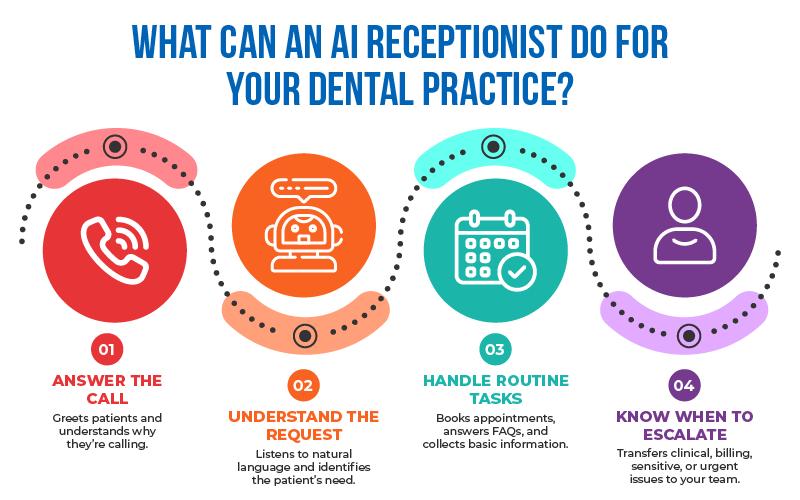
1. When a Patient Calls Your Practice
Instead of listening to a voicemail message, let your patient get a real reply. It makes the one in distress feel heard and valued.
The dental AI receptionist can welcome your patients using your practice’s name and stating what they need.
For instance:
“Hello, you have reached the Team at AZ Dentistry. How can we help you today?”
Nothing fancy, just honest and real. That is the whole idea.
2. AI Understands the Request
Instead of having to navigate through the long tedious task of “Press 1, press 2” menus, the system actually listens to natural language.
For example, a patient could say: “I need to reschedule my cleaning appointment for next week.”
The AI can understand what the patient is asking for and check the open slots in the scheduling system if it is integrated.
3. Receptionist Handles the Routine Task
The AI is capable of finishing the reservation or responding to the inquiry only if everything is in order. If the client asks something beyond its capabilities, it should realize when to stop.
This is essential.
You don’t want an AI to provide an unqualified response to questions concerning someone’s diagnosis, treatment, drug prescription, or crisis condition.
4. It Hands Off When a Human Is Needed
A good AI virtual receptionist must have proper escalation rules. For instance, the following can be related to the given subject:
- Routine question → AI handles it
- Appointment request → AI handles it
- Complex billing issue → Staff member
- Clinical question → Dental professional
- Potential emergency → Appropriate urgent escalation
This borderline is essential since AI should help clinical decision making, not replace it. The ADA insists on the importance of human control and responsible employment of AI in dental practices.
AI Receptionist vs. Virtual Dental Receptionist
Another term you may see used by companies is virtual dental receptionist. The difference can be ambiguous because businesses do not always use these terms consistently.
However, in general:
| Feature | Human Receptionist | Virtual Dental Receptionist | AI Receptionist |
| Answers calls | Yes | Yes | Yes |
| Handles routine questions | Yes | Yes | Yes |
| Appointment scheduling | Yes | Yes | Yes |
| Works after hours | Usually no | Often | Often |
| Handles multiple calls | Limited | Depends | Yes |
| Needs breaks | Yes | Depends | No |
| Handles complex human situations | Strong | Strong | Limited |
| Clinical judgment | Human | Human | No |
So don’t get too caught up in the terminology.
When looking at different options, see what the system does and don’t focus solely on its name.
How to Introduce AI Without Disrupting Your Practice
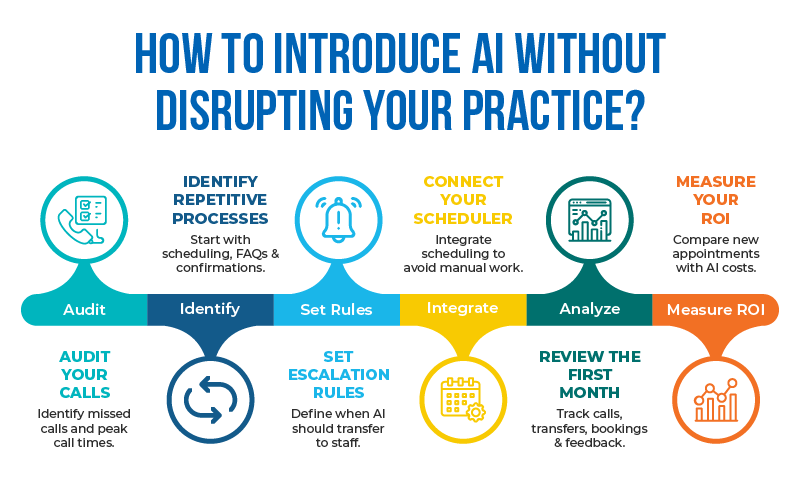
You do not have to implement AI in your practice from day one. Gradual rollout is key:
Step 1: Audit Your Calls
Look through the last month of calls and analyze when and why you missed any call.
Step 2: Identify Repetitive Processes
Start from making appointments, answering FAQs, and confirming calls.
Step 3: Outline the Exception Rules
Establish what situations will result in AI transferring calls to your staff.
Step 4: Connect Your Scheduling Software
Ensure that booking appointments do not create extra work for your practice.
Step 5: Analyze the First Month
Look at call data, forwarded calls, missed chances, and clients` feedback.
Step 6: Calculate the True ROI
Compare the number of additional appointments made to the cost of the solution.
This provides you with something more meaningful than a fancy software demonstration: data from your own office.
You can read about AI in Dentistry in our Blog:
How Much Does an AI Receptionist for Dentists Cost?
Sign up now to try a free Tamil matrimony experience and see why Prime Rishta could be your ideal choice of matchmaking portal while in search for best Tamil matrimony site in New ZeThis is the time.
The cost of AI receptionists can differ quite a bit due to the volume of calls features integrations and other factors incorporated and pricing models.
The market examples in 2026 indicated that the prices per month varied from as low as $200 to as high as $1200, or even higher. Though, some simple examples actually listed much lower starting prices. The same occurs for Indian vendors, the prices will be roughly between 12000 and 22000 given offerings of coverage.
So our general advice still stands on totally stopping to compare prices each month before you know the benefit you get for that.
Look for These Costs
- Monthly subscription
- Setup or onboarding fee
- Per-minute or per-call charges
- Phone number charges
- PMS integration costs
- Additional locations
- Extra call volume
- Human transfer charges
- Messaging or SMS fees
A $99 plan will look sweet and all, until you realize that it does not actually schedule appointments or connect to your practice software.
The lesser-valued number is not enough signification for the system we get.
What Others Don’t Tell You About AI Receptionists

The simple selling point for most AI receptionists is the number of calls answered. That’s not what should matter to you.
The important thing is what occurs after the call.
A receptionist can handle 500 calls a month and still provide very little value if those calls don’t result in scheduled appointments, completed visits, or beneficial patient follow-up.
You can read more in our Blog:
1. Measure Recovered Opportunities, Not Just Answered Calls
- Missed calls after implementation
- New-patient enquiries
- Analysis from the number of new-patient enquiries to the clinic per month across.
- Appointed between
- Number of completed encounters
- Bookings outside of office hours
- Check for appointments
Transfered calls to staff calls needing human attention this will give you a much clearer picture of whether the system is actually benefiting your practice.
2. Your AI Needs Boundaries
A good dental AI receptionist would not try to individually answer every question. It should know when to say, in effect, “Let me see if I can call somebody in for that”.
A human may be needed to: answer clinical questions, in emergencies, in unusual billing situations, and with sensitive patient issues.
Honestly, this is one of the options that shows that we have built a good system.
3. Integration Matters More than the voice
Even a remarkably human sounding virtual dental receptionist isn’t much good if your people are logging in every appointment themselves.
Before buying anything, ask:
What is the fate of the data after the call concludes?
If the answer is to copy across three different systems, continue to searching.
4. Don’t automate a broken process
This one kind of flies under the radar.
And if your practice is chaotic around how you make or reschedule appointments, how you schedule patients or how you followup; then adding AI will not solve these problems…
All it probably does is speed up what is already a mess.
Write down your fundamental call processing before implementation. Then determine what can be handled through automation and what will remain with the client service team.
What Should You Check Before Buying One?
Rhetorical situations. This is maybe the most important part of the whole article.
Do not go for an AI Receptionsist just yet, the demo is so human like!
Inquire about the effect of breaking down:
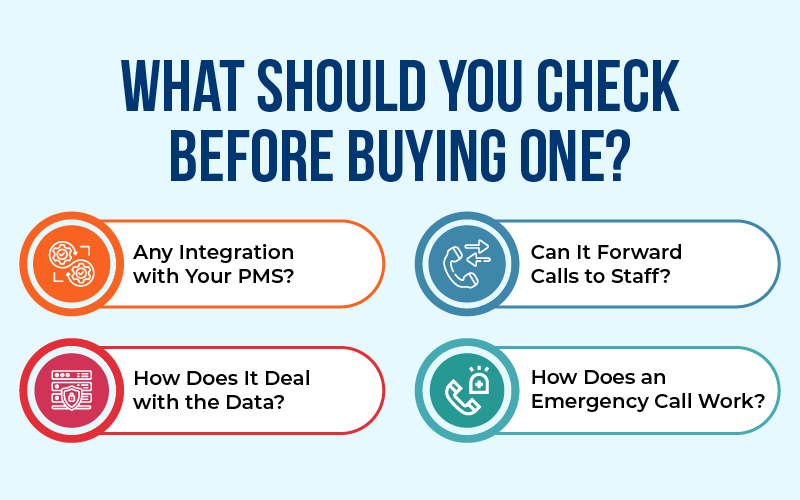
Your Checklist
Any Integration with Your Practice Management Software?
If your team still has to manual copy every appointment, then you have created another task instead of eliminating one.
Can It Forward Calls to Staff?
You require unambiguous pathways to escalate.
Your procedures should be able to identify approved information and booking rules, hours, and escalation procedures.
How Does It Deal with the Data?
For U.S. practices, this is very important. The requirements for HIPAA business associate may be triggered if an IT vendor generates receives maintains, or transmits protected health information on your behalf. HHS points out: “A covered entity that uses a cloud-based service to store or process electronic protected health information (ePHI) would be required to establish a business associate agreement with the cloud service provider and ensure that the provider complied with applicable HIPAA requirements”.
Don’t just take a sales person at his word when he says “HIPAA compliant” Ask him for the documentation and what data he is actually handling on that system.
How Does an Emergency Call Work?
Your AI should have clearly specified bounds and escalation procedures.
Your aim isn’t to artificialise the AI to sound like a dentist. It’s to ensure it recognizes when it’s not.
Is AI Receptionist Technology Right for Your Practice?
It may make sense if:
- You are often interrupted by your phone.
- Staff under constant pressure to cope up with heavy call volume during peak hours.
- You get loads of enquiries out of hours.
- Your team uses an inordinate amount of time on scheduling appointments.
- You have several different sites.
- Your receptionist is always being disturbed.
Your new-patient phone calls are reducing. You’re no longer logging potential new-patient calls or are recording less.
According to how low your call volume is, or if you already have great work flow that handles the calls well, it could be less effective.
There’s nothing to be gained by including (yet another) piece of software.
As ADA’s 2026 survey-based research, 43.3% of the dentists reported to have used AI application (in at least one task during practice). What it took off was improving administrative work, but still far away from dentists’ cautious attitude toward clinical decisions.
The Bottom Line
An AI receptionist for dentists shouldn’t be a flashy subscription you just have sitting silently on your bank statement each month.
Begin on a reduced scale.
Review the call history of your practice for the past 30 days: how many calls were received during the time your staff were unavailable? After hours? New patient calls? Conversion to appointments?
Next, see just what the smallest improvement might be worth.
The real question is not if AI will be answering your calls, but when.
The real question is whether you are losing important conversations just because nobody can answer every call at the precise instant.
Frequently Asked Questions
An AI-receptionist for dentists interacts with patients by answering phone calls, directing first level questions, making appointments, confirming reservations and taking after-hours inquiries. The bot’s capabilities are in combination with your front-desk staff to decrease missed calls while not substituting for the human support required by your patients.
Cost with features and functionality cost varies with call volume features integrations and provider. Many systems have a monthly subscription, and some also have per minute or per call charges. Find out the total cost including set up, software integrations, transfers, and add on charges.
Yes. When added to your practice management or scheduling software, a dental AI receptionist can schedule, reschedule, and confirm appointments. Make sure that this type of dental AI is compatible with your practice management or scheduling system and that it handles your appointment rules correctly.
While an AI receptionist for dentists may assist HIPAA-compliant workflows, you shouldn’t assume this is the case for every provider. Find out how patient data is maintained, accessed, and secured, and if the vendor offers the right Business Associate Agreement when needed.
It can, in particular if missed or after-hours calls translate into lost schedule opportunities. Track calls answered, appointments scheduled, visits completed, and revenue produced. Compare those outcomes to your overall AI expenses to determine if you’re seeing value from the system.