Imagine you check your call log at the end of a busy day and find three missed calls from numbers you don’t recognise. One may be spam and another a sales call. One could be a new patient, and you have no way of telling which.
The hard truth is that you might never learn whatever that was actually about.
In a dentist’s office, a missed call could represent numerous situations wherein it can be an inquiry made by a person who needs a dental checkup, or someone with a toothache, or a parent looking for a reputable dentist. AI for dental practices can help recover some of those calls, but only in certain situations, and this article explains which.
Some parts of AI call handling are well established, and others are still maturing. Answering routine questions and capturing caller details are the most proven uses. Booking directly into your practice software is newer and depends on your system.
Learn more about uses for Ai in our Blog:
It doesn’t replace your receptionist or turn your practice into some futuristic robot clinic. It’s much simpler than that. AI can answer routine calls, capture patient information, schedule appointments, respond after hours, and help ensure fewer potential patients fall through the cracks.
Let’s look at how it actually works.
Why Missed Calls Cost Dental Practices New Patients
Now think about your rush hour. Maybe the receptionist is signing in a patient, another asking about costs, a third calling to reschedule, and the phone rings. If someone doesn’t pick up the phone, the caller might call another practice, or leave a message, or just wait. Your telephone logs will tell you what your experience is.
This is one of the biggest reasons missed calls should be given more value in dental practice or any other practices. Your staff can be outstanding with patients and still be losing inquiries when the volume of calls simply gets too high for the front desk to keep up. One reason missed calls deserve attention is this: a new patient inquiry is often the first contact a practice has with someone.
AI becomes the first point of contact at those busy times. Your system can be designed with an AI phone assistant to provide general help, take contact details, discover what the caller wants and maybe even be asked to book an appointment.
For example:
“Hi, I’d like to schedule a cleaning, but I’m not sure what times you have available.”
Instead of sending them to voicemail, an AI assistant can respond immediately and guide them to the next step.
That’s a small interaction. But for a practice owner, small interactions can add up quickly.
What an AI Receptionist Can and Can’t Handle After Hours

Now it is evening. Someone has procrastinated on their dental problem all day and has just decided to call a dentist and your office is closed. They may try to leave a message. They may choose to look for a different practice and call the first office where they get a live person. Which of these things occurs more frequently at your practice can be determined with your after-hours call data.
AI isn’t in the market to replace what you do, just to ease how you handle your business and patients the right way.
The useful part is that it is a lot simpler.
It is capable of dealing with the repetitive questions that don’t need judgement for clinical needs, but also ensuring that there is a skilled human involved when it is necessary.
For instance, the caller could be inquiring about office hours, location, insurance accepted, or the days and hours that he/she is able to schedule an appointment.
Take a typical month in your call log, and see how many times you’d have to jump through those filters. If it’s a lot, then definitely automate.
What is the need to make all incoming callers wait until the next day?
How AI Helps Callers Get from Inquiry to Booked Appointment
Getting someone to call your practice is only half the battle. The real challenge is moving them from “I’m considering seeing a dentist” to “I’ve scheduled an appointment.”
A potential patient may call and say they’re interested in an appointment, but have to call back. Your receptionist might take a message and hang up.
Then Tuesday turns into Wednesday. Wednesday turns into next week.
You know what this story ends with.
AI can assist in reducing that drop-off by providing the next step. If your system permits it, an AI assistant can gather the information required for the scheduling and suggest methods of open appointments.
Imagine a caller saying:
“My tooth has been bothering me, and I’d like to come in this week.”
Instead of a vague “We’ll have someone call you back,” the conversation can move toward a specific next action.
This is extremely important because not all references to lost patients by dental practices involve them going to another dentist! You should be able to see from your call and appointment books if this is happening at your practice.
If your callers are getting through but not booking, fixing the booking step might have more impact than adding website content. If very few people are getting through at all, then the website might be the one that is constraining the process.
You can read more in our blog :
Which Routine Calls Are Worth Automating
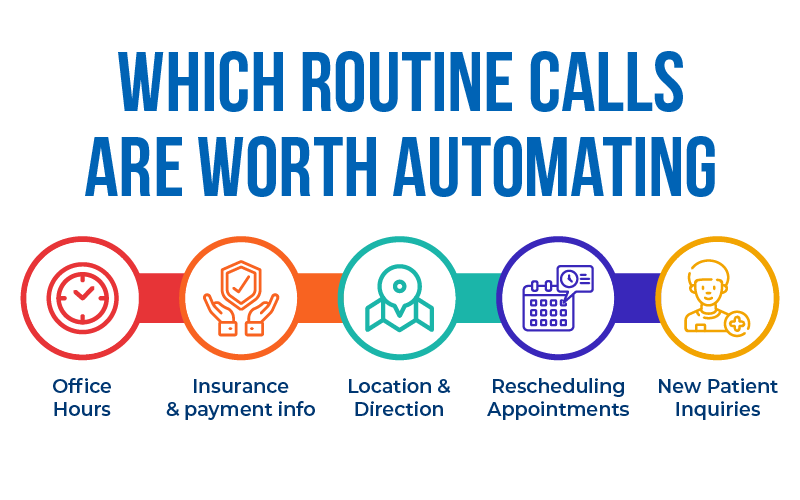
Let’s face it, quite a number of the questions dental teams get asked are often the same.
- Will you tell me the office hours?
- ‘Do you take our insurance?’
- “Your location? “
- How can I reschedule my appointment?
- “Are you open to taking on new patients?”
None of these are insignificant. They’re just repetitive.
And rut work can erode a receptionist’s day without her even noticing.
A well-designed AI assistant can take care of the appropriate routine questions, freeing up your staff to deal with those conversations where the human touch is really required.
What you’re not trying to do is de-humanise your practice. You’re giving your staff ‘hour-glass’ jobs so they have time to be with the patients in front of them.
Here are some other ways to harness the power of AI resulting in a more responsive practice over different forms of communication. Keep in mind, some of these require integration with your existing system.
The main point is to know when and where to use the automation, and when it is not required.
How to Choose and Test an AI Call System

Purchasing an AI tool does not necessarily mean they will fix the missed-call issue.
If it isn’t integrated smoothly with your scheduling system, if your team doesn’t understand when to pass it over, or if the AI health scares you–well, you have more software to add to the stack.
No one wants that.
As we examine how AI receptionists are used in dental practices, an important step is examining the real patient experience.
Start with Your Missed Calls
Review your phone logs and determine when you miss calls? During lunchtime? During heavy booking blocks? After hours?
It’s the pattern.
List Your Repetitive Questions
Let your front desk candidate list all the questions and jot them down to feed your automation system. It is significant to train your automation system to answer exactly what is asked.
Decide Where Humans Must Step In
Any matters related to diagnosing, treatment recommendations, emergencies, patient-sensitive circumstances, and complex billing inquiries may require a trained staff member to handle it.
AI needs to know that it has reached that boundary.
Track What Happens After the Call
Forward only to the phrase ‘talking to the AI, ‘ which falls at the end of the second page.
Track things like:
- Total calls answered
- Inquiries by new patients
- Confirmed appointments (booked)
- Calls diverted to staff
- Inquiries outside the normal working hours
- Missed-Call Recovery
- Appointment conversion ratios
Offers you with something far more practical than a slick dashboard. You get to see if the system does anything to aid your practice in securing deals that would have otherwise gone elsewhere.
How AI fits alongside your front-desk team
There is the temptation to view AI as a future reduction in human input.
That’s the wrong way round in dental and healthcare practices.
Your front desk staff does not just answer the phone. They soothe anxious patients, troubleshoot appointment mix-ups, hear the word “urgent”, contact the appropriate clinicians, and foster the impression that someone is actually concerned.
That’s something that calls for automation.
Handling a routine phone question at 7:30 PM? Taking a new patient call while your receptionist is assisting a walk-in? Returning a call that came in after business hours?
These are different.
If used correctly, technology like AI can help reduce missed calls and lost patients for dental practices, without removing the human element from the patient experience.
And that’s probably the question worth asking before you invest in anything:
Where is your practice losing patients simply because nobody had time to answer?
Start there. Pull your call data, find the gaps, and see whether automation can close them. You might discover that the next patient you gain isn’t hiding somewhere in a complicated marketing strategy.
They’ve already tried to call you.
Frequently Asked Questions
Not if you use it well. AI is able to take care of ordinary calls and common questions, with your staff managing interactions that require understanding, discernment, and a real human touch. That’s what makes the difference.
Your call doesn’t have to go to voicemail. The AI can answer your call, comprehend the patient’s requirements, gather their information and, per your configuration, assist in booking an appointment or direct the call to your team.
That helps you answer more quickly and snag those questions that may otherwise go unanswered. It’s not a one click show, but if you take a call every time even when you’re not there, you give the prospect less reason to go elsewhere.
That’s a valid concern. AI should operate within transparent limits, using sanctioned data, and deferring sensitive and clinical questions to your team. We create a proper knowledge base based on which the AI will answer the queries. Anything beyond it, will be handled by your team members.
You really do not need the hundreds of calls for the lost opportunities to make a difference. Just five or six unanswered calls could have been someone ready to book. So begin by looking back at your recorded calls and pinpointing where you are losing potential clients.