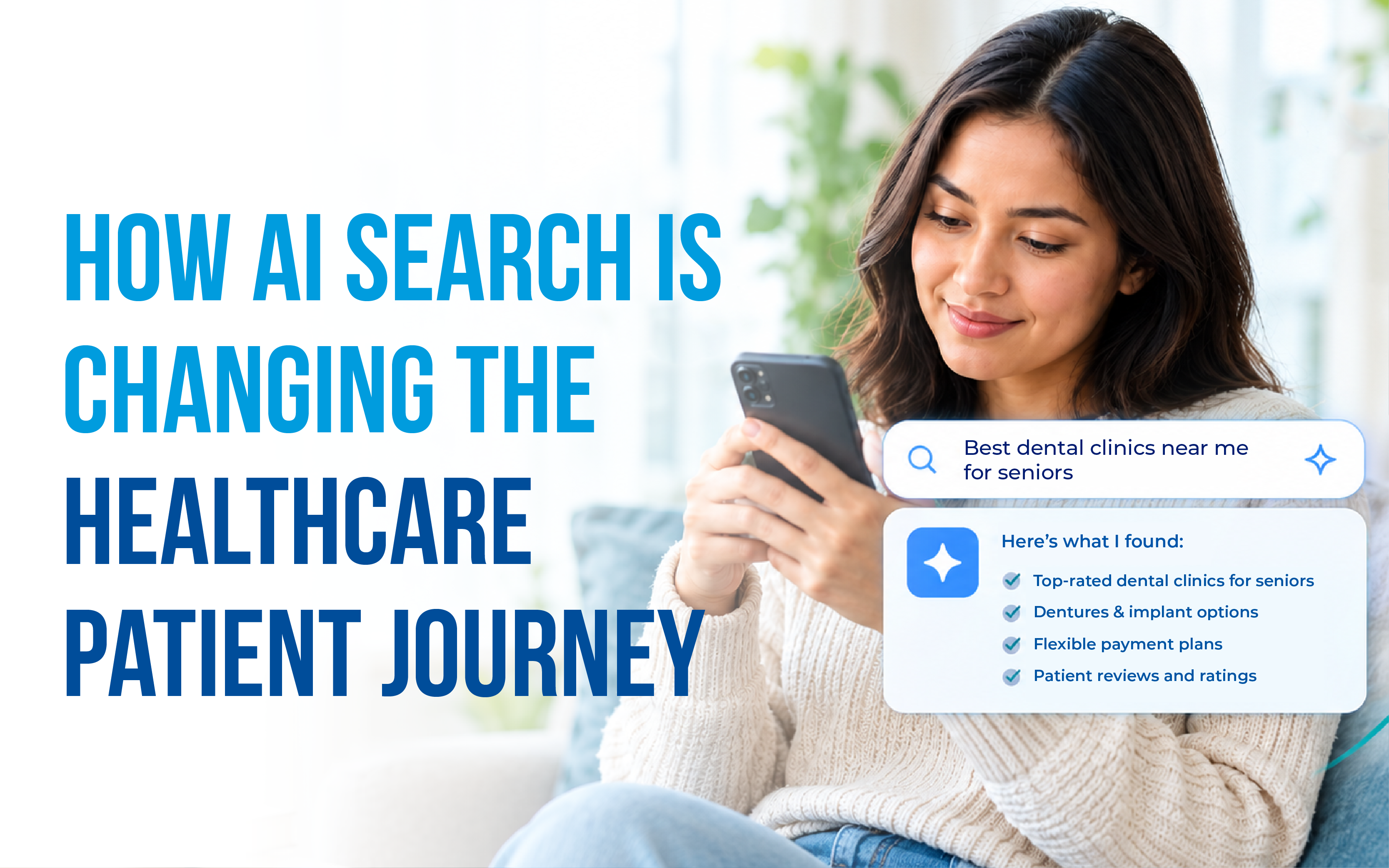
Usually, an average search returns a list of website addresses. People click through different websites to read descriptions from various authors and try to decide which information is legitimate.
How does AI help with this process? AI can condense the information and sometimes answer the user’s question. For example, the responses can be based on a summary or can contain related queries or definitions, etc.
Let’s say an athlete has leg trouble. He is trying to find out what he can do about it, whether time off would help or it’s time to see a doctor. AI-powered search can help him answer several questions in a single query.
This way of searching makes it easier for people confused by specific terms to find medical information. However, remember that AI-provided answers are not a diagnosis.
What the Numbers Tell Us
Recent reports offer some useful context for healthcare marketers:
- Search visibility for health-related topics. AI Overviews appeared for 84% to 92% of searches in five health-related query categories in the AI Index Report 2026 sample, as summarized by RAISE Health. These numbers show the prevalence of AI-generated summaries in that sample; they do not represent the coverage rate across all searches, countries, and health care topics.
- Invoca’s 2026 Healthcare Consumer Experience Report found that US consumers in its study were using generative AI to research higher-cost, high-stakes purchases. Its survey alone can’t paint the same picture of patients’ behavior in other markets.
Learn more about Generative Engine Optimization for Healthcare providers in our blog:
How AI Search Influences Each Stage of the Patient Journey
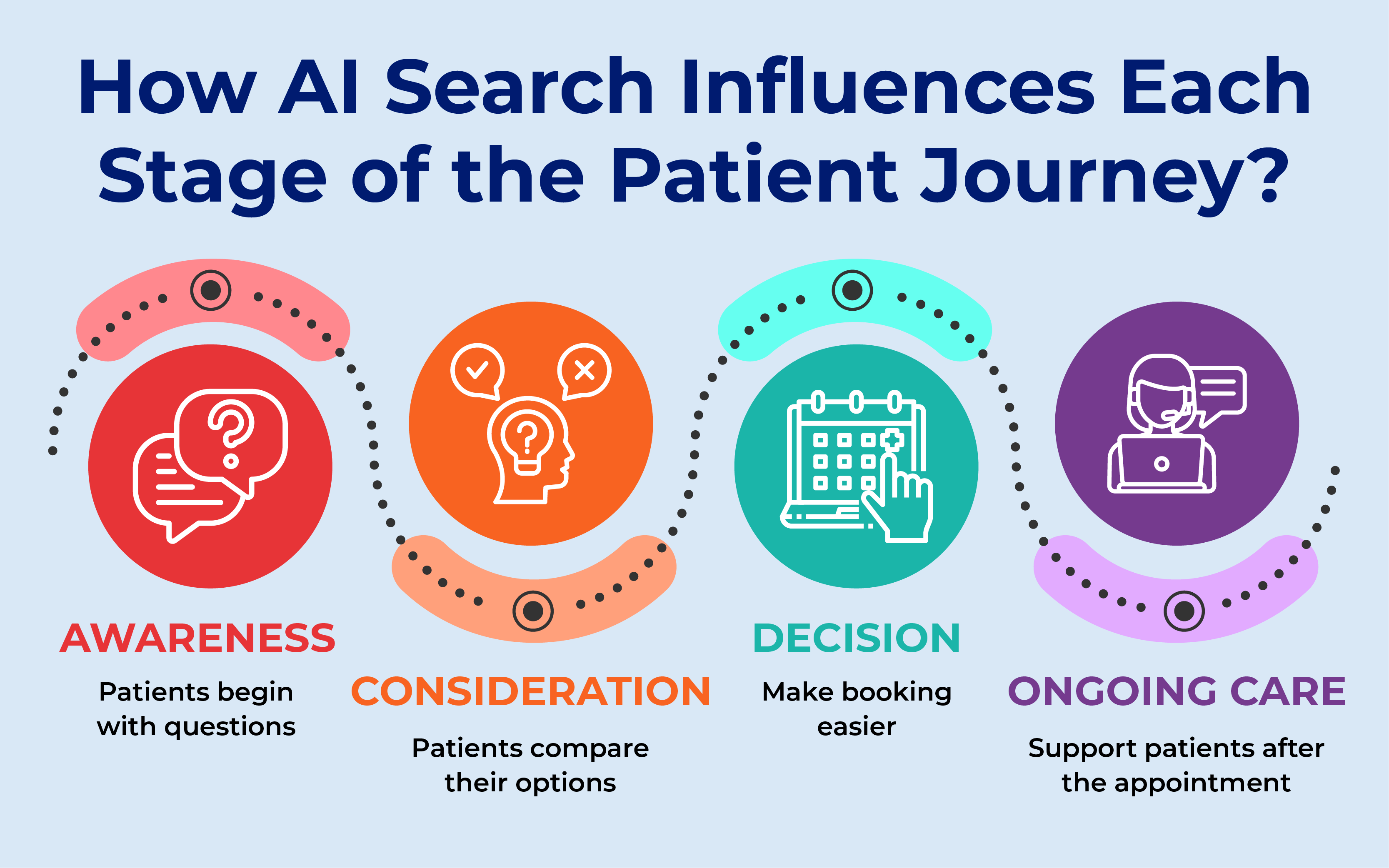
The path to the appointment is often not linear. An individual might research a symptom, talk with a relative, and look at different services, then circle back to an earlier question before booking an appointment.
AI search optimization can affect every stage of decision-making in these processes.
Awareness: Patients Begin With Questions
Patients have many reasons for their search queries, including starting a search before they’re confident in the results. Back pain with no clear cause, new fatigue, a recent diagnosis, and more may throw the patient for a loop. They might not search “cardiologist near me”; they might type, “What should I ask a heart doctor about recurring chest pain?” These more specific search queries give your practice room to speak to your audience.
Consideration: Patients Compare Their Options
After they know what to look for, patients usually research providers before they make contact. They look up doctors’ qualifications, available treatments, reviews, clinics, and pricing. AI driven personalization can help with this research, but it may exclude suitable clinics or show incorrect information. Healthcare organizations should maintain accurate, consistent, and easily searchable online resources so that patients can quickly confirm facts and confidently choose where to go for care.
Decision: Make Booking Easier
Getting in the door doesn’t always get you in to see the doctor. Patients may worry about paying, a first-timer might wonder whether they need a GP referral, or they may simply not know what to expect on their first visit. Making an appointment can be equally daunting. Whether it’s an appointment button on the healthcare provider’s website, a simple contact form, or clear directions and information about services, the aim is to put the patient at ease.
Ongoing Care: Support Patients After the Appointment.
What happens after an appointment? Patients may want to learn more about their condition, seek help with recovery, or have additional questions after their visit. Healthcare professionals can help patients understand reliable health information, get reminders about upcoming appointments, and know the next steps after a visit. These resources should complement personalized clinical guidance. When sharing patient stories, photographs, and content, remember to protect confidential patient information.
How Healthcare Providers Can Improve Visibility in AI Search

No dependable shortcut ensures an AI system will suggest a specific hospital or clinic. However, healthcare providers can improve their websites and make key information easier for both people and search systems to find.
Answer Questions Patients Genuinely Ask
Start with questions doctors, nurses, and reception teams hear regularly, such as how to prepare for diagnostic tests or what to expect during dental procedures. Make sure it’s understandable and easy to comprehend. All of the terms that may be unfamiliar should be explained and the information should be presented in an organized way, and correct suggestions regarding the next steps should be made.
Learn more about AI Receptionist in our blog:
Show Who Stands Behind the Information
Content plays a critical role in impacting health-related decisions making trustworthiness very important. Authors and qualified medical reviewers must be identified, relevant credentials disclosed, and cited sources must be reputable and up to date. Uncertainty must be acknowledged and education distinguished from specific medical advice. Google emphasizes the importance of trustworthiness in their helpful content guidelines.
Keep Local Information Accurate
Accessibility and location are important factors considered by patients. It is extremely important for your web pages and the business listings to have the correct name of the clinic, the address, the phone number, the working schedule, and description about the services provided, as well as the physician’s profile, which contains information about how to make an appointment. This should be checked every time there are any changes in the services provided or the working hours. It is important to keep the information correct to be reachable by the patients and to avoid any possible information loss.
Make the Website Easy to Navigate
Make the service pages, doctor profiles, educational articles, and appointment information organized. Learn how to write titles that are informative, headings that capture attention, paragraph writing that is clear and to the point, and internal links that are relevant to your content. Structured data implementation is important. Following Google’s AI guidance, it can be said that conventional SEO techniques are still useful. Avoid creating articles for the sake of AI, instead focus on user friendly and quality content.
Measure Outcomes, Not Just Rankings
Keep track of organic traffic, queries, bookings, calls, submissions and visibility on local search. Please monitor AI referral traffic only if you are notified of it by the analytics. Keep in mind that patients may discover your clinic through AI but return through another channel. Evaluate performance and look for important trends rather than declaring every alteration in traffic to be the result of AI.
Risks Healthcare Providers Need to Consider
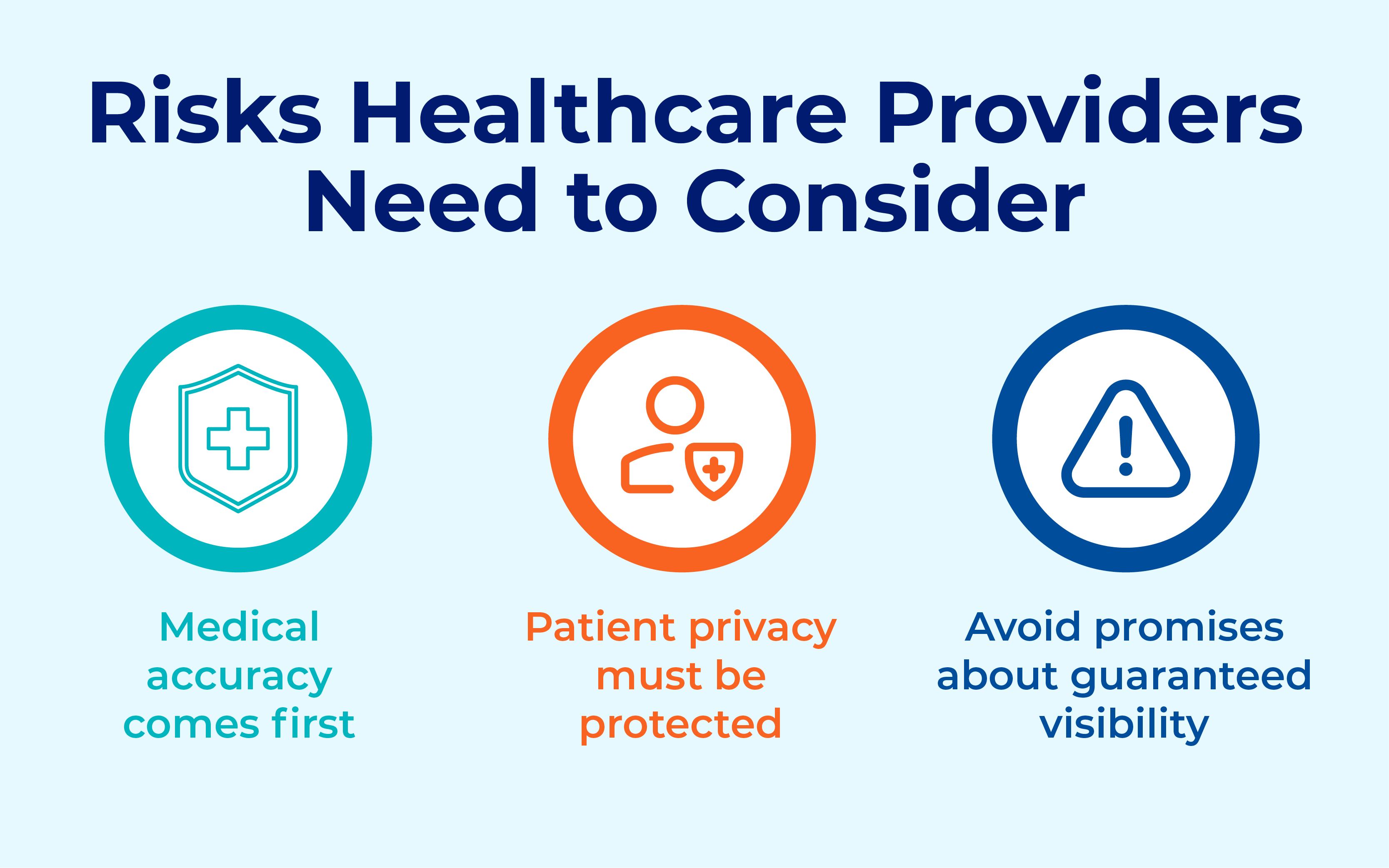
Using AI to unlock discovery can help people find the information they need, but providers should handle the change carefully.
Medical Accuracy Comes First
Under some circumstances, generative AI in healthcare can propagate incorrect information as a result of its limited intelligence capabilities. Patients could, thus, confuse general data with individualized advice.
Healthcare Content like any other content, medical content needs to be verified through research to guarantee its accuracy and point out when individuals need to consult professionals and get a health evaluation. Marketing purposes can never be more important than the accuracy of medical knowledge.
Patient Privacy Must Be Protected
Confidential information is also gathered through online forms, communication channels, and chatbots. The healthcare sector needs to keep track of what types of information its IS collect and the usage it makes of them. It also has to comply with regulations protecting a person’s confidentiality.
Never forward any relevant data to the AI program unless you have that person’s explicit permission.
Avoid Promises about Guaranteed Visibility
Watch out for companies claiming to have “quick ChatGPT solutions” or “quick flights on AI SERP.” Search engine technology evolves rapidly, and companies do not dictate the methods artificial intelligence employs to rank search results. Concentrate instead on site speed, content, and every other sign of authority upon user arrival.
How Scrum Digital Can Help Healthcare Providers Adapt
Specialists need to be able to bring the patient requirements into the business requirements and recommend evidence-based practice rather than spending hours creating content.
Let Scrum Digital assist your healthcare organization at every step.
- Patient Journey: What do people need to know before choosing a service? What needs to be done by the patient? When should an appointment be booked?
- Information Audit: Discover questions providers did not think to ask, descriptions of services that they didn’t understand, and suggestions to help providers improve their data sources.
- SEO Fundamentals: Understand the technical indexing of the site and local business SEO.
- Content Creation: Create content that highlights actual patient concerns and enables medical care.
- Conversion Optimization: Make appointment booking, contact forms, and mobile navigation simpler.
- Results Analysis: Analyze requests, visibility, inquiries, bookings, and referrals each time.
Start With the Questions Patients Need Answered
AI search optimization and artificial intelligence in healthcare changing how patients research health issues, compare providers, and take the next step. Healthcare organizations can become an informative resource sooner in that process.
Start with the basics. Answer patient questions, stay current on care details, showcase your medical expertise, protect privacy, and make booking care as easy as possible. Next, review results and work to minimize what your patients still find difficult.
The person may be searching when they’re not yet ready to book an appointment. The reader may just need an approachable, knowledgeable voice and a bit more guidance on what step to take next.
If a healthcare site offers those things, it’s not just bringing in visitors; it’s giving them more confidence to make better healthcare decisions.
Would you like to grow your healthcare brand’s presence in both traditional and AI-driven search? Scrum Digital can help you find content opportunities, ensure your SEO principles are sound, and build a patient-centric digital strategy aligned with how we search now.
Frequently Asked Questions
Yes, it’s an effective way for patients to find your practice when they’re looking into symptoms, treatments, and providers. But none of our agencies promise AI recommendations. Reliable information, relevant content, and strong SEO basics all help your practice be in a good position.
Not necessarily. Old-fashioned SEO is still important. Answer the real patient questions, optimize service pages, demonstrate your expertise, and make your site user-friendly. These will all help you rank with conventional search engines as well as in AI discovery.
That’s a valid question. Maintain the accuracy and timeliness of your website content and make it simple to fact-check. Differentiate between health educational content and medical opinion and always get health information checked by an expert before publishing.
Ignore rankings. Monitor leads, phone calls, appointment bookings, organic traffic, referral data from the sources where it exists. It is normal for a patient to find you by AI then go through another channel on the way back; don’t blame every movement in your business on AI search.
No responsible agency can guarantee that. AI search results are subject to change, and we cannot control, which clinics these systems recommend. Scrum Digital can assist in strengthening your content, technical SEO, local visibility, and patient journey to increase your chances of being found.