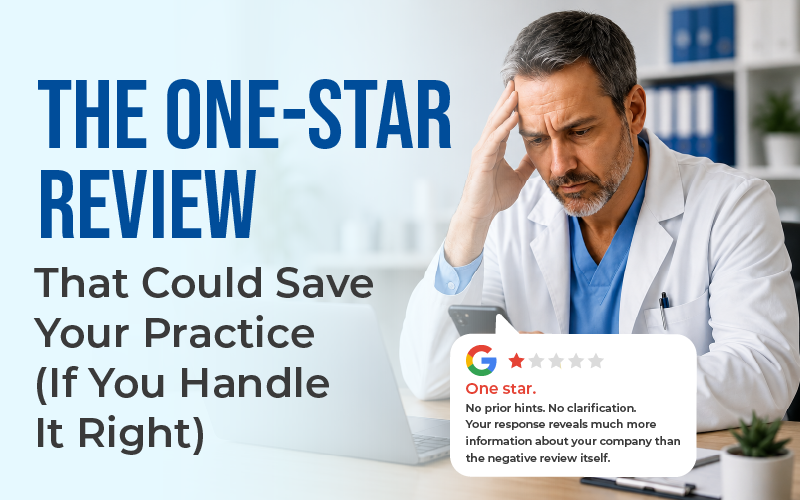
You’ve had a productive week. Your schedule is completely booked. Your employees are occupied with work. Your patients are satisfied.
And then you get a notification on your phone.
⭐☆☆☆☆
One star.
No prior hints. No clarification. It might contain a lengthy complaint. It might contain nothing at all.
Your heart sinks. You remember every patient who visited during the last several days, trying to pinpoint what went wrong. Was it the delayed appointment? Was it the billing issue? Was it the unnaturally stressed receptionist?
In fact, all owners of medical establishments have been in this situation and will definitely experience it.
The first impulse is often emotional. You want to justify yourself. Explain everything. Probably convince yourself that it is an unfair review.
Breathe out.
Your response reveals much more information about your company than the negative review itself.
Why Patients Read the Bad Reviews First

Here’s a fact that is not so commonly acknowledged.
Whenever you are searching for a new dentist, doctor, physiotherapist, or veterinarian, what is the first thing you do?
Checking thousands of five-star reviews doesn’t make sense for most people. They go for the one-star reviews and look for the negative experiences.
Why is it so?
Because nothing sounds more suspicious than perfection, when customers read complaints from dissatisfied clients, they judge not only the person who made the complaint but also the company.
Questions running through their mind include:
- Does this practice listen?
- Are they respectful?
- Do they blame patients?
- Do they take responsibility?
- Would I feel comfortable if something went wrong?
In many cases, your response answers all of those questions before they ever book an appointment.
Why a One-Star Review Isn’t Always Bad News
It might be odd to hear this. However, having only excellent reviews might seem dubious at times.
Consumer behavior research reports that customers prefer to purchase from companies with evaluations ranging between 4.2 and 4.8 versus those with perfect scores.
Realistic variations of evaluations prove to customers that your facility provides services to actual clients with various needs.
The key factor is not about the existence of negative reviews. It’s in the way these reviews are processed.
How to Respond to a 1 Star Review on Google

This question arises repeatedly: What is the best way to reply to a 1-star review on Google?
There is no one way of answering
But there is a reliable approach.
Step 1: Express Gratitude
This might seem like a strange idea, but it really works.
Acknowledging someone’s feedback can de-escalate the situation.
For instance:
Thanks for sharing your experience.
Step 2: Show Compassion
Keep in mind that your customers always want to feel empathized with, regardless of whether you see the problem the same way or not.
Instead of saying: We don’t agree with you.
You can say: It’s unfortunate that our establishment didn’t meet your expectations.
It is all in the little details.
Step 3: Safeguard Patient Privacy
Don’t ever go public with details of a patient’s treatment. Rather, ask the reviewer to have a private conversation.
Example:
“Please allow us to understand the situation better and contact our office to discuss it with us.”
This preserves confidentiality while displaying professionalism.
Step 4: Clarify and Not Argue
Clarifications must be kept brief—no need to write lengthy paragraphs explaining why the patient is wrong.
Readers are not interested in a court trial. Readers want to know that you treat customers with dignity and respect even in difficult situations.
Step 5: Keep the Door Open
It is advisable to go a step further. In some cases, a reviewer will change the rating after a sincere conversation.
And in some cases, they won’t. Either way, it is all good.
Common Mistakes When Dealing With Negative Online Reviews
Here’s where many practices unintentionally make things worse.
| Mistake | Better Approach |
| Ignoring reviews | Respond promptly and professionally |
| Arguing publicly | Move conversations offline |
| Blaming the patient | Focus on understanding concerns |
| Copy-paste replies | Personalize each response |
| Revealing patient information | Protect privacy at all times |
| Responding emotionally | Stay calm, factual, and respectful |
Many operations unintentionally make the situation worse.
Do you see what I see? Most issues arise not for a lack of strategy, but for a lack of emotion.
That’s why it’s important to have a process of responding to reviews. Not because every negative review is warranted, but because being consistent will make people trust you.
Turn Negative Feedback Into Operational Improvements
While the best companies do react to feedback from their consumers, they do more than that.
They analyze it.
For example, if many patients mention the same points about long waiting times, ambiguous billing processes, difficulty contacting the receptionist, or quick consultations, it indicates a problem with operations.
Instead of asking,
“With whom is the responsibility?”
Ask,
“Will the same issue occur again?”
Issues repeat frequently, instead of happening only once.
How to Encourage More Positive Reviews Without Asking for Perfection

People mistakenly believe that the best solution to a bad review is to “have” dozens of five-star reviews compensate for it.
This is not the right approach.
The correct approach involves ensuring a continuous flow of real reviews from real clients.
When such genuine reviews are done regularly, periodic negative reviews are not as disturbing.
The issue is that happy clients usually do nothing to report their satisfaction. On the contrary, dissatisfied clients are much better motivated to tell about their negative experience.
This situation can change if the review process is made as easy and fast as possible.
Practical Ways to Encourage More Reviews
- Request reviews just after the appointment.
- Provide the direct link to submit the review through email or SMS.
- Make your staff ask for the review politely so they don’t feel obligated to do it.
- No matter if the feedback is good or bad, be thankful for it.
- Do not offer any rewards for the review, as it can break the platform rule.
In a nutshell, the advantages of acquiring your client’s reviews are significant, as they will help to get the message across to your audience.
When Should You Report a Bad Online Review?
Not all unfavorable evaluations should be disputed by you. Sometimes, the reviewer may have had an unpleasant experience. Regardless of this being the case, some criticism from the reviewer is a normal element of running any business.
Nevertheless, any negative review of your business should not be reported in every situation.
Consider Reporting a Review If It
- Contains abusive or offensive language.
- Includes hate speech or personal attacks.
- Is clearly fake or posted by someone who was never a patient.
- Promotes another business or contains spam.
- Shares false information that violates the review platform’s policies.
It is essential to know the platform’s review rules before proceeding with your report. It is never possible, nor desirable, to take away genuine feedback because it does not provide positive impressions of your service.
A transparent review profile gives more assurance to customers than one that seems to be perfect in all aspects.
Create a Review Response Process Before You Need One

The majority of practices only reply to reviews when there is a problem. Instead, it is better to establish an uncomplicated system that everyone adheres to.
A Practical Review Response Workflow
| Step | Action |
| Monitor | Check review platforms daily or use reputation management software. |
| Verify | Confirm the details internally before responding. |
| Respond | Reply professionally within 24–72 hours whenever possible. |
| Resolve | Contact the reviewer privately if further discussion is appropriate. |
| Review | Identify recurring issues and improve internal processes. |
| Follow Up | Encourage the patient to update their review if their concern has been resolved, but never pressure them. |
Having a documented workflow helps your team respond consistently, even during busy periods.
Every Review Is Free Market Research
Here is another viewpoint that is often neglected. Numerous companies invest several thousand dollars to obtain customer feedback through surveys.
Establishments have to analyze customer feedback available through previous reviews. Reviews can unveil aspects that organizations may not have been recognizing.
Is it possible that in peak hours your reception is really busy?
Or perhaps your appointment notification system is not as efficient as it should be?
And patients enjoy the services but complain about management. These operational aspects don’t get discussed during business meetings, but they come out in reviews.
Thus, organizations should treat their reviews as valuable solutions rather than disturbances.
Learn more in our blog:
Your Response Becomes Part of Your Brand
Consider the last instance when you perused an aggressive online conversation involving a company and its client. You’ve likely forgotten the initial grievance.
But you probably remember the company’s conduct. It happens because people judge not only the review but also the person issuing a response.
A composed and understanding reply demonstrates strong conviction in the future. At the same time, a defensive response shows weakness.
A Final Thought
No practice is beyond reproach.
All providers can and will receive negative reviews.
Patients’ desires, feelings, and experiences differ, and no practice can do everything well at all times.
The practices that gain enduring trust are the ones that respond well to complaints, learn from criticism, and strive to improve.
If you supervise your practice’s online reputation, don’t consider the unfavorable review a failure. Consider it a chance to show your potential patients the kind of care they expect from you.
If you have trouble dealing with reviews, local SEO, and online reputation management along with running your practice, it may be time to hire a marketing professional who specializes in healthcare.
Frequently Asked Questions
The first step to responding to a one-star review is to thank the customer for leaving feedback. Then, express understanding and empathy towards their concerns without being defensive. It would be great if you could ask them to take the conversation off public channels.
Always keep the tone of the response professional and neutral since it is highly likely that prospective clients will review it.
Try to avoid getting into any arguments with the customer publicly. Be polite in your response, and mention the importance of feedback for your organization.
It might be appropriate in the case of a one-star review to thank the customer in your response. Just express your desire to know what the issue was. Make sure to invite them to call your company directly.
Yes, a genuine criticism may uncover problems in the way you run your business that you were unaware of before, for instance, your shortcomings in communicating with patients, setting appointments, and telling patients how much they owe to you for services rendered. Thoughtful replies, moreover, reflect your commitment to taking responsibility for your actions.
It is advisable to see each negative review as an opportunity to learn and show professionalism in your response. Reply promptly, don’t let emotions take over, protect your patients’ confidentiality, and use the feedback you receive to improve the patient experience instead of trying to defend your reputation.