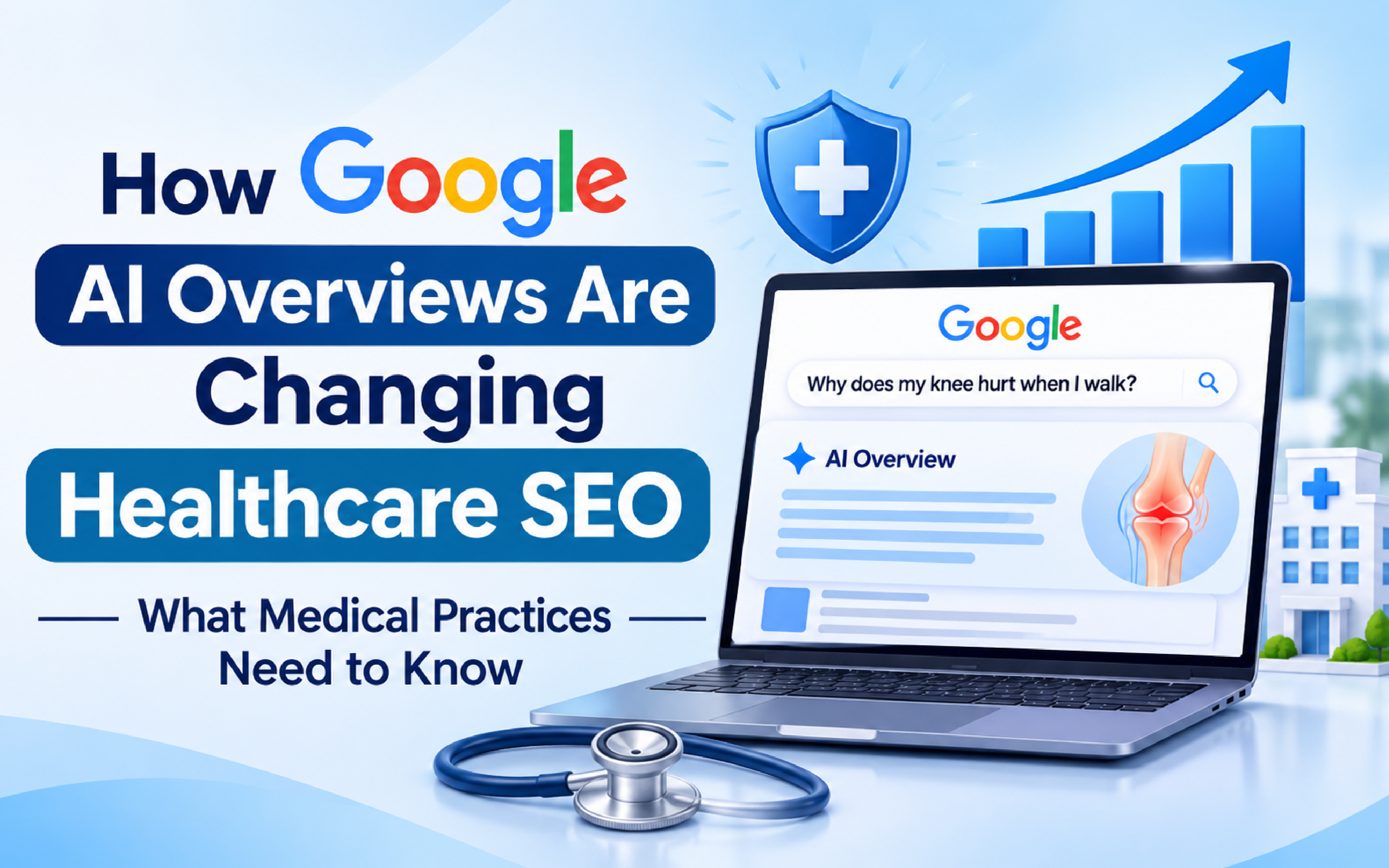
Imagine a patient typing “Why does my knee hurt when I walk?” into Google Search. A few years ago, the individual would read a handful of articles on various websites and visit the doctor after getting a sense of the pain’s potential cause. Nowadays, Google can answer most or all questions before the user clicks a link.
Interesting change, isn’t it?
Google AI Overviews are transforming how healthcare consumers seek medical information, compare services across providers, and choose a facility. For physicians, hospitals, clinics, and offices, such changes bring new challenges, because it is important to make a medical website visible in search results even if Google provides an answer directly.
One area where these changes require careful attention is healthcare, because people look for medical information for more than just curiosity. Often, they worry about their symptoms or seek reassurance.
A strong online presence can help patients find your practice and consider visiting.
Google AI Overviews Are Changing How Patients Find Medical Information
The feature known as Google AI Overview provides AI-generated summaries at the top of search results. Google combines information from various sources and provides links so users can dig deeper.
For instance, when someone searches “What are the early signs of diabetes?”, they may receive an AI-generated summary of signs, risk factors, and when to consult a doctor.
The patient may get the basic idea about the query without opening several websites.
Accordingly, this affects how people search. In the past, your article could have appeared on the first page of search results and received regular clicks. But now Google can combine information from different sources to prepare a summary for search users.
The Numbers Tell an Interesting Story
According to a report published by Google on August 6, 2025, AI Overviews have increased Google’s overall usage statistics by more than 10% for queries where AI Overviews were used across major markets like the US and India.
Moreover, based on the company’s information released on June 3, 2026, AI Overviews had reached over 2.5 billion active users monthly across various countries worldwide.
Healthcare SEO Is Becoming More Dependent on Trust and Medical Expertise
A common mistake healthcare companies make is thinking a healthcare website is the same as a lifestyle blog. The company posts generic articles, stuffs in keywords, and waits for Google to deliver results.
Honestly speaking, this approach doesn’t make sense.
The healthcare sphere falls under Google’s “Your Money or Your Life” (YMYL) category, which means false information can seriously affect someone’s health and treatment. That is why Google pays closer attention to content quality and reliability, as well as the presence of expertise indicators.
For example, an article written by a cardiologist has a different level of credibility than an anonymous article that simply copies the information from various similar websites.
What Should Your Medical Website Demonstrate?
- The following are useful strategies to build trust and credibility:
- Professional credentials: Present the qualifications, area of expertise, and work experience of the physician responsible for preparing the material.
- Medical examination of the text: Indicate the name of the healthcare professional who reviewed the text.
- Credible references: Include references to reputable medical associations, articles, and relevant clinical guidelines.
- When relevant, provide original insights from medical professionals.
- Who wrote this material? Explain to the audience which professional is responsible for writing the text.
Zero-Click Searches Are Becoming a Real Concern for Medical Practices
Patients can get the information they need without visiting the facility’s website. This is one of the major challenges of search functionality powered by artificial intelligence (AI).
A report by Search Engine Land, released in November 2025 and based on Seer Interactive’s research, shows that organic click rates for informational keywords with AI Overviews fell by 61% from mid-2024 to September 2025.
The research examines informational keywords occurring on the websites of 42 companies, resulting in 25.1 million organic impressions.
Why Does This Matter for Healthcare Providers?

Let’s say your clinic has a blog that includes the keyword “signs of vitamin D deficiency.” In the past, people looking for that information would click the link to your article, visit your site, and discover your services.
With AI, that person might just find a brief explanation online from Google.
Of course, your article is contributing to the answer, but that potential patient might not visit your site.
Therefore, being dependent on organic traffic as the only metric of SEO effectiveness is increasingly less valuable.
Healthcare professionals should also keep an eye on:
- Visits for appointments.
- Phone calls coming directly from organic searches.
- Visibility in local and treatment-related searches.
- Engagement of visitors on service pages.
- Branded searches and clinic awareness.
- Even a lower number of website visitors can create significant business outcomes.
Generative Engine Optimization Is Becoming Part of Healthcare Marketing

Another term that keeps popping up in SEO discussions is Generative Engine Optimization (GEO).
The principle is pretty straightforward. Your content should be informative and organized to gain prominence in AI-generated search results.
While classic SEO focuses on achieving better rankings in search results, GEO emphasizes whether AI technologies can understand your message and assess its trustworthiness to use it when answering related queries.
This opens new horizons for healthcare providers.
How Can Your Practice Improve Its AI Search Visibility?
First, understand the questions patients ask. For instance, a physiotherapy clinic could publish the following content:
- How long does one undergo physiotherapy after a knee replacement?
- When should one consult a physiotherapist for lower back pain?
- Can physiotherapy treat a severe frozen shoulder?
- What occurs during the first physiotherapy session?
Next, make sure every article directly answers the question, includes the necessary medical facts, and explains what comes next.
Learn more about “How AI Search Is Changing the Healthcare Patient Journey” in our blog:
Local Healthcare SEO Matters More When Patients Are Ready to Book

Patients looking for causes of migraines are most likely early on their healthcare journey, while those looking for neurologists are further along the process and trying to make an appointment with a specialist. Patients with different searches have different needs. AI-generated summaries can help, but local searches remain crucial when it’s time to find a healthcare provider. So local SEO must be a key part of every medical practice’s digital marketing strategy.
Practical Ways to Strengthen Local Visibility
- Optimize your Google Business Profile: Double-check that your practice name, address, phone number, working hours, website, and services are accurate.
- Create location-based service pages: For example, the dental clinic in Lucknow can create separate pages for dental implants, root canal treatment, and orthodontics.
- Ask for authentic patient reviews: This helps potential patients learn from others’ experiences.
- Keep business information uniform: Match the practice information on your website, Google Business Profile, and reputable healthcare directories.
A good healthcare SEO agency knows local visibility means more than adding the city name to each page. Patients need to know where your practice is located and how to reach you.
Learn more about Healthcare SEO in our blog:
Your Website Needs to Answer Patient Questions Better Than Generic Content Does

While there may be concerns, AI summaries aren’t always bad for every kind of healthcare website.
According to Google, websites appearing in AI-assisted search results can drive traffic. In its August 2025 statement, the company notes a relatively stable overall trend in organic click volume and a significant improvement in click quality.
We should also consider findings from independent studies, as the actual picture may differ from case to case.
However, this is a great opportunity for you.
After reading an AI summary, the patient will likely want more detailed information. They might be looking for a particular treatment, comparing doctors, or figuring out how to book an appointment with you. This is when your website should be ready.
Build Content Around Real Patient Concerns
Avoid writing another standard article with the title “Benefits of Dental Care.” It’s much better if you focus on issues like:
- Dental Implants: List who is suitable for the procedure, what to expect during surgery, and the recovery process.
- Cardiology: List symptoms that need urgent medical help and consultation.
- Orthopedics: List essential things patients should know before considering knee replacement surgery.
- Dermatology: List skin irritations that need a dermatologist’s evaluation.
Ask specialists to make sure all medical claims are valid. Don’t forget to describe the constraints of the claims, note when individual assessment is needed, and avoid indicating treatment outcomes.
Pages dedicated to the services you offer should receive a similar level of focus and attention. Patients need access to information about the health solutions you offer, who administers them, and how to contact you.
This is exactly where a healthcare agency’s services can be invaluable for marketing.
A Memorable Takeaway: The Practices Patients Trust Will Have an Advantage
Healthcare SEO has entered a new phase. Patients now find information through AI responses, search journeys are becoming more unpredictable, and medical practitioners need to consider how they build trust online.
One prediction puts this into perspective. A February 2024 Gartner report projected a 25% decrease in traditional search engine usage by 2026 due to increased use of AI chatbots and virtual assistants. However, this is not a proven 2026 decrease.
In my opinion, healthcare practitioners should prepare for a search reality where fewer users click on informational searches, but the value of users coming to their websites is growing. You don’t need to keep up with every new trend in AI marketing. Focus on your customers first.
This means ensuring your medical information is reliable, building a trustworthy online image for your physicians, optimizing your local listings, and making the appointment booking process easy.
Scrum Digital believes healthcare marketing should help people access quality services with confidence.
When the next patient searches for recommendations on Google, will your clinic be one of the reliable sources?
Your healthcare SEO strategy should answer that.
Frequently Asked Questions
They could, especially for question-based searches where Google provides an answer, like informational searches. But quality healthcare content may still attract relevant traffic from people seeking answers, treatment, or an appointment.
Focus on publishing clinically sound content and improving local rankings. Make it easy for patients searching for a specific specialist or treatment to find your clinic details.
Not exactly. All your existing SEO fundamentals still count. Focus on improving content quality and depth, demonstrating medical authority, establishing local dominance, and being a valuable, informative resource for people searching for healthcare.
Google AI Overviews show related websites in response to a query. Good medical and business details, plus service pages, rank higher in Google.