During implant surgery, the phone is ringing. Meanwhile, the office phone starts ringing again as the receptionist is checking in/patient. Then later, you find out a voicemail came in that you didn’t hear until 6:30 p.m.
Somewhere in all that chaos is a new customer who really just wants to know, “Do you have anything available next week?”
You could easily lose a potential prospect if you ignore that call.
That’s one reason why AI voice agents for dentists are starting to be talked about. The biggest reason isn’t that dentists suddenly want robots answering the phone, but that your dental team simply doesn’t have the time or bandwidth always to be there.
To be frank, it is not really fascinating anymore to find out if AI can answer phones. They can.
The real question is: does it handle routine conversations naturally without making your patients wonder if they have been passed to a machine?
How Dentists Can Use AI Voice Agents
1. What Are AI Voice Agents for Dentists?
Imagine an AI voice agent doing a phone-based assistant job – listening to customers’ questions, comprehending their intentions, giving answers naturally, and performing various operations based on the setup.
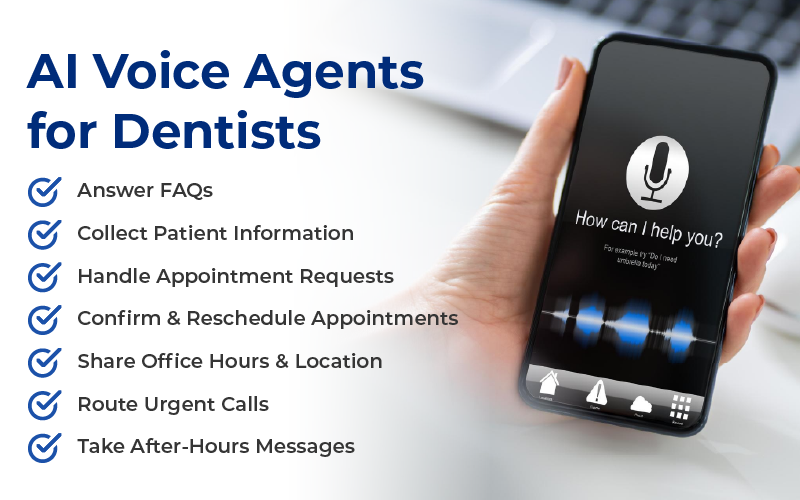
A good AI-based dental receptionist can be a great help with common conversations such as:
- Answering frequently asked questions
- Collecting basic patient information
- Helping with appointment requests
- Confirming or rescheduling appointments
- Explaining office hours and location
- Routing urgent or sensitive calls to your team
- Taking messages outside normal office hours
Your dental AI shouldn’t act as a dentist. It shouldn’t assess tooth pain, suggest treatment in a free spirit, or confidently answer questions it doesn’t understand.
Its job is to take over repetitive daily tasks, freeing up your team, while still knowing when a human needs to step in.
You can read more in our blog:
2. Why Dental Practices Are Looking at Call Automation
Dental practices handle a lot of phone work in one or more ways. Calling to book an appointment. Asking about coverage. Getting a cancellation. Getting directions. “Can I make a change to my appointment?” “Will you see new patients?” “My crown has fallen off, and what if I do?”
None of these conversations are actually difficult. These just get consumed by time.
This is precisely where call automation for a dental practice provides real value.
Imagine this scenario
The patient called at 8:15 p. m. when your office was closed and found a very different reception than expected.
Somewhere, the call was intercepted by an AI receptionist program that did the basic things: asked the patient for their name and address, answered a few simple questions (how long it takes for a new appointment to be scheduled, etc.), and explained the process of getting back to the patient after all that info has been gathered.
The next day, you would see how easy and fast it is to find all that information and add it to the patient’s file.
That’s not even close to what a receptionist does; it actually reduces the number of interruptions a receptionist faces.
3. How AI Voice Agents Help Dentists Without Replacing the Team
The biggest mistake is to consider AI only as “employee replacement.” If anything, the best use case for various practices is “AI + (reliable) human team.”
A receptionist makes judgments and decisions but also shows compassion, understands the big picture, and, with one of these human things, says, “I get how this can be irritating; just give me a moment, and we’ll find out what’s going on.”
AI is great for tasks where consistency and repetition are key.
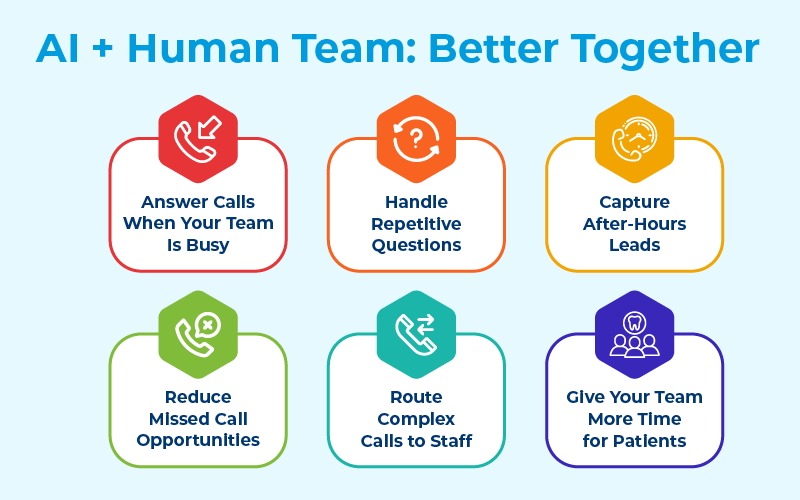
How AI voice agents help dentists
- These days, automated call systems have become so sophisticated they can even answer calls for you when your team is busy or handling other tasks.
- They can also free you from repetitive questions and let your humans spend their time in more meaningful ways.
- You may also capture leads after working hours if your virtual assistant is available even then.
- This helps you avoid missed call opportunities, as your virtual assistant can answer calls even when no human is available.
- You can let the chatbots decide whom to route a conversation to if human intervention is required only after a certain point, for example, or in case of complex issues.
- They can also help free up your team so they can physically attend to patients in the practice.
The intention of all these measures is not to make your practice seem less human, by the way. It’s about empowering your team with more free time to be human and do the things that make you love your work most.
4. Your Dental Patient Experience Starts Before the Appointment
Something is easy to overlook: the experience a patient starts long before they sit in your chair for a dental check-up.
In fact, it is a small detail, such as your first communication with the patient,t that may set the entire tone for their relationship and the patient’s comfort when it comes to dental visits.
Some patients may consider calling the dentist just a small obstacle. They possibly are concerned about how long it has been since their last appointment. They may be worried about the cost, or they may really hate making phone calls.
An overly complex, confusing automated menu would likely aggravate a patient’s fears and discomfort.
A virtual receptionist in a well-designed dental office can simplify the first communication, reducing the patient’s anxiety even slightly.
5. Dental Voice Agents Need Clear Boundaries

This is the point where practice owners need to slow down and not fully automate yet.
Dental voice agents should have clear restrictions.
Take, for example, a caller saying, “My face is swelling, and I’m having trouble breathing., It’s not a normal appointment or cancellation call, so the system shouldn’t try to troubleshoot by providing alternative treatments and/or asking a bunch of questions; instead, it needs an escalation process suitable for such circumstances.
However, questions about diagnosis, treatment decisions, medication, etc., that involve clinical aspects of your business should be handled based on the clinical and safety policies set by your practice.
A Useful Rule
Automate the predictable. Escalate the important.
Before deployment, map out:
- What the AI can answer
- What information it can collect
- Which actions it can take
- Which calls require staff intervention
- What happens when it doesn’t understand
- How sensitive patient information is handled
The technology matters, but the guardrails matter more.
6. How to Introduce AI Without Freaking Out Your Patients
You don’t always need to be very direct. You don’t need to say, “Well done, you’re talking to our computer robot.”
But you must not deceive the caller by pretending you are something else.
A simple, transparent introduction can work:
Hello, I am the virtual receptionist for [Practice Name]. I can schedule appointments and answer frequently asked questions, or transfer you to our staff.
Fine. Human communication. Friendly. Behaving naturally, no. No to excessive playing.
What Should You Automate First?
Don’t start by handing your entire phone system to AI. Start with the calls your staff answer dozens of times a week.
Good candidates for automation
| Call type | Automation potential |
| Office hours | High |
| Location and directions | High |
| Appointment requests | High |
| Appointment confirmations | High |
| Basic scheduling questions | High |
| Routine administrative questions | High |
| Complex treatment questions | Low |
| Emergencies | Human-led escalation |
| Sensitive complaints | Human-led |
8. The Real Value of AI Voice Agents Isn’t the Voice
It is tempting to evaluate AI voice agents based on how human they sound. They sound quite human, and that’s one reason they have become so popular.
Still, you interact with a very human voice through a system that is otherwise quite frustrating. The key measure, because of this, is whether the technology will make your practice more responsive without making patients feel like customers on a conveyor belt. It is the perfect mix.
Final Thoughts
Actually, the biggest advantage of dentists using AI voice agents isn’t about completely humanizing the dental practice. Its main function is to make certain parts easier and handle repetitive tasks that humans really don’t like doing.
Just set the robot to handle similar calls and let your employees do the work where human touch is crucial, like being understanding, giving reassurance, empathizing, and getting a better understanding of the patient. That said, not every part of a dental visit should be left to AI. A dentist who is a real person, not just a machine, can handle those delicate issues where the patient’s emotions and sensitivity come into play.
In any case, all the patient needs to know is that if they really need a person, a real human being will be available right then.
Frequently Asked Questions
Frequently Asked Questions
1. What are AI voice agents for dentists?
AI voice agents for dentists are voice phone systems that make a dentist’s office telephone system more effective. These systems answer calls, handle common tasks like call transfers, ask callers questions, and collect their information. Beyond answering calls, they make the whole office more efficient by taking calls when the dental office receptionist is on holiday, when a staff member in the dental practice is overburdened, when a receptionist is busy, or when the dental office is closed in the evenings.
2. Can an AI dental receptionist book appointments?
Yes! Your dental AI voice agent enables dental clinic appointment booking, so you can schedule a dentist’s visit just like a live receptionist does. The system will be set up to handle appointment requests, confirmations, cancellations, and reschedules in line with your dental practice workflow and clinic software. The dental AI receptionist can also gather basic information, then hand off anything more complex to the main front-desk crew.
3. How do AI voice agents help dentists?
Dental AI voice agents mainly reduce interruptions and missed calls. They can explain your policy, handle routine tasks, act as a friendly voice, and answer calls when you are at lunch or the practice is closed, while your staff works with patients at the practice. They can take and log appointment requests, confirmations, and routine admin questions so your team members can fully attend to the dental patients at your practice.
4. Will AI voice agents hurt the dental patient experience?
Not necessarily. A dental patient experience can, on the contrary, be enhanced by a cleverly designed dental AI voice agent system that quickly gives callers the information they need and offers convenient service beyond office hours.
5. What calls should dental practices automate?
A dental patient experience can, on the other hand, be enhanced by a cleverly designed dental AI voice agent system that can quickly give callers the information they need and offer convenient service beyond office hours. It’s still crucial to make sure there is no human interaction only on sensitive or tricky issues, and that there’s a well-publicized option to speak with real people.