At some point along the journey, ‘Customer Experience’ evolved from a mere subjective measure. Whereas before it was represented by courteous service personnel and an acceptable email newsletter, today it’s generally a matter of keeping a customer for 5 years rather than losing them within the first year solely because of an issue with the checkout process.
In 2026, companies that will be major players in gaining loyalty are not just those that believe they are “customer-centric”; they also rely on AI-based Intelligent CRM systems that can truly think, anticipate, and adapt.
This isn’t marketing hype; itis happening.
Let’s talk about how AI-driven CRM customization and integration will continue to change the landscape of Customer Experience, and why you will probably have no choice but to act on it.
Customer Experience in 2026 Looks Very Different

You probably experienced this if you interacted with almost any modern-day brand, whether you saw it in:
- An email you received at just the right time,
- A chatbot that seemed to know how to help without being confused,
- A customer support agent who already had some knowledge of your issue before you even described it.
This isn’t some kind of magic; it’s just an artificial intelligence-powered (AI-powered) CRM system operating behind the scenes.
Today’s CRM platforms are more than just digital rolodexes; they are becoming an interactive ecosystem that draws data from:
- Marketing campaigns
- Website activity
- Purchase history
- Customer support
- Social media
And in 2026, they will take this a step further by using the data they collect to act on behalf of the customer in real-time.
From Data Storage to Intelligent Action

Traditional customer relationship management (CRM) systems focused primarily on data storage. In contrast, AI-powered systems analyze the data to produce useful information for businesses.
Organizations implementing an AI-driven intelligent CRM system can perform activities such as:
- Forecasting churn prior to it occurring
- Providing next-best poses to improve sales team effectiveness
- Initiating offers on an individualized basis based on user behavior
- Automatically segmenting users with no manual intervention
Companies are moving from reacting to customer behavior to anticipating customer behavior. This transition is fundamentally changing how all organizations will experience customer relationship management, both from an employee and a customer perspective.
Personalization

The difference between “Wow, they know me” and “How do they know this?” is subtle but important.
By the year 2026, personalization means much more than inserting a first name into an email’s subject line. Personalization is about delivering relevant content to consumers.
With advances in AI CRM systems, marketers will now be able to:
- Segment their data based on user behavior rather than just demographics.
- Identify the next best action based on a customer’s past behavior.
- Adjust message timing based on how frequently a customer engages with the brand’s products.
- Dynamically recommend the best product for each customer at any time.
Where many brands fall short is in automating all aspects of their marketing strategy.
When this happens, the customer begins to think they are being completely managed by an automated robot with a marketing education.
The Sweet Spot: AI + Human Judgment
Using a CRM system as a co-pilot, not just an automated tool, is how savvy teams perform at an optimal level. AI-powered systems provide data-driven insights; the ultimate decision on tone remains with the individual.
For example, a D2C company with an adaptive CRM may find that some of its repeat purchasers have stopped ordering for 3 months or more. Based on that data, AI has suggested they run a loyalty promotion. The Head of Marketing makes minor language changes to their promotion, e.g., by referencing seasonal purchase habits.
What will the output be? A series of well-thought-out email promotions.
This is how strong customer experience on the web looks today: great technology combined with human nuance.
CRM as the Leading Salesman
There was a time when advanced CRM customization felt reserved for enterprise giants. But that gap? It’s shrinking fast.
Modern CRM platforms for small businesses now come with built-in AI modules, automated workflows, and third-party integrations that used to require entire IT departments.
And small teams may benefit the most.
Why Smaller Teams Win With AI-Driven CRM
Small businesses typically have:
- Less siloing
- More rapid decision-making and approval processes
- Closer ties with their clientele
When you add AI-enabled CRM capabilities to this equation, you end up with speed and personalization. For example, imagine your e-commerce brand has only 12 employees:
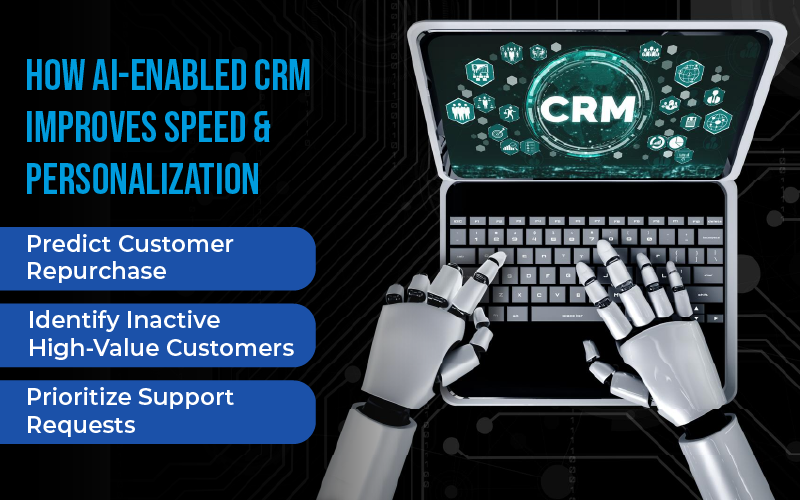
- The CRM provides an estimate of when existing customers are likely to re-purchase
- It identifies high-value customers who haven’t sold with you in a while
- It determines the order in which support requests should be prepared
Agile CRM as a Growth Tool
We need to discuss this bigger idea beyond just the software itself. A true holistic CRM structure defines how to value the customer, not how workflows are executed.
A CRM system with flexibility will provide users with a flexible experience and, in turn, deliver a customer experience that meets today’s needs.
Quarterly Analysis
In 2026, progressive organizations will conduct an interesting exercise every quarter as follows:
- Quarterly analysis of where customers may have dropped off
- Quarterly assessment of what’s cumbersome within each of the 6 touchpoints.
- Quarterly assessment of what “friction” is taken for granted because “that’s just how it’s done.”
After EACH quarter, CRM will be modified based on the analysis’s findings/results. By incorporating automation into CRM, unnecessary processes may be eliminated, or how leads are routed may be modified. Each CRM is a “living system”; therefore, the way a customer experiences (CX) directly affects how the CRM operates. The result will be more precise communication, less time spent replying to customers, more likely messages sent, and fewer awkward experiences for customers.
AI-Driven CRM Is Redefining Loyalty

Rewards from various programs or discounts used to dominate loyalty earlier. Today, loyalty is about convenience; if your customer’s experience on your website feels intuitive, consistent, and considerate of time, they remain, not because they have a lot of rewards points to collect, but simply because it’s easier to keep the account than to lose it.
Through an integrated, AI-driven CRM system, convenience can be easily achieved by:
- Anticipating customer service needs
- Providing cross-sell purchases when the customer is likely to purchase
- Eliminating repetitious questions
- Providing complete context to your teams instantly
- Eliminating “can you tell me your account number again?”
- Eliminating your need to explain the same question three times.
In short, your CRM offers continuity, which builds trust more quickly than any marketing plan.
What This Means for Your Business
If you’re currently managing an organization, this isn’t really about acquiring new tools. It’s about asking tougher questions.
- Is there a customization of our CRM based on our actual customer journey?
- Are our systems integrated, or are we just pretending to integrate them?
- Are we leveraging insights from an AI perspective, or are we simply gathering AI insights for exhibition purposes?
- Does our current CRM feel effortless to use for consumers from the outside?
Consumers do not care about the type of software you have. They care about the experience of their interaction with you.
And in 2026, consumer expectations are extremely high for frictionless applications, predictive recommendations, and instant support, and your competitors are already testing frameworks for intelligent CRM solutions that leverage AI to the fullest.
So the distance between “fine” and “fantastic” will only increase.
The Final Thought
If you removed your brand name from your emails, landing pages, and support replies, would anyone recognize your experience as uniquely yours? Or would it feel interchangeable?
AI-driven CRM customization isn’t about technology flexing. It’s about shaping moments. The tiny, invisible ones that stack up into loyalty.
So maybe the next step isn’t asking, “Do we need a new CRM?” Maybe it’s asking, “Does our CRM actually understand our customers better than we do?”
And if the answer is no, well, you know what to do.
Frequently Asked Questions
An AI-based CRM does more than store contact information like a traditional CRM. It will analyze your customers’ behavior, predict their needs, and recommend next steps on an ongoing basis. It can also help your business better anticipate customer actions, creating a smarter, more efficient total customer experience than with traditional CRMs alone.
An AI-based intelligent CRM solution connects sales, marketing, and support data to create a 360-degree view of your customers, enabling more relevant messages, faster responses, and proactive issue resolution. This will help any business consistently improve customer experiences across all customer interaction touchpoints.
Without any question! The best modern small-business CRM platforms offer affordable customization and automation. Even small teams can leverage AI insights to prioritize leads, personalize how they communicate with prospects, and improve support efficiency, all of which will greatly enhance the overall online customer experience without requiring large staffing.